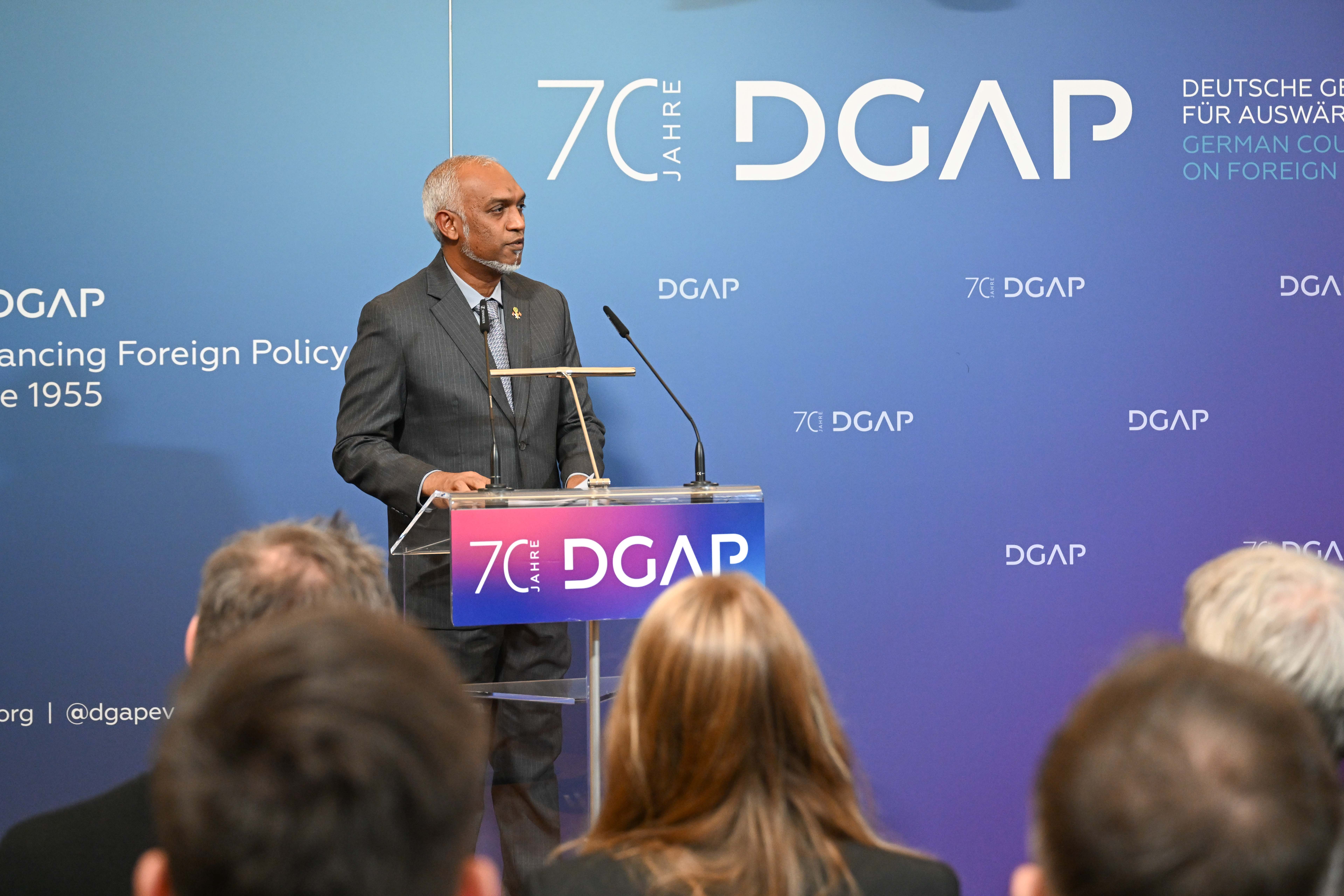
Ambassador Rolf Nikel, Vice President of the German Council on Foreign Relations (DGAP)
Excellencies,
Distinguished Members of the German Council on Foreign Relations,
Ladies and Gentlemen,
Assalamu A’laikum.
It is a great honour to address the German Council on Foreign Relations, an institution that has helped shape strategic thinking in Germany and far beyond. DGAP stands for a simple but powerful idea: that foreign policy is ultimately about responsibility, responsibility to one’s citizens, to one’s partners, and to the international system itself.
Germany’s foreign policy tradition, rooted in multilateralism, international law, and cooperative leadership, resonates deeply with countries like mine. For small states, these principles are not abstract ideals. They are the foundations of our security. And, quite simply, of our survival.
Today, I would like to share a perspective shaped not by land borders or continental powers, but by a domain that increasingly defines global stability.
The ocean.
For the Maldives, the ocean is not a backdrop to foreign policy.
It is at its very core, the Maldives is an ocean state. Our territory is overwhelmingly maritime. Our economy, our culture, and our history are inseparable from the sea. More importantly, our future, our sovereignty and continuity as a nation, is inseparable from how the international community governs the ocean.
For much of modern history, foreign policy has been land-centric. Power was measured in territory, borders, and armies. But the strategic realities of the 21st century tell a very different story.
Over 70 percent of the Earth’s surface is ocean. More than 90 percent of global trade moves by sea.
Undersea cables carry the data that powers the global economy.
The ocean regulates the climate and sustains biodiversity and underpins food security for billions.
Despite this, the ocean has often remained underrepresented in strategic and diplomatic thinking, treated as a sectoral issue rather than a core pillar of global governance.
For the Maldives, this distinction does not exist.
We are an ocean state in the truest sense. Our territory is more water than land. Our history, economy, culture, and security are inseparable from the sea.
As such, our foreign policy is increasingly shaped by a simple but powerful reality:
The future of international order will be determined, to a significant extent, by how we govern the oceans.
Nowhere is this more evident than in climate change.
For the Maldives and increasingly to the rest of the world, climate change is no longer a future scenario. It is a present reality. Rising sea levels, coral bleaching, saltwater intrusion, and increasingly volatile weather patterns are already reshaping our economy and our way of life.
Yet climate change is not only an environmental issue or challenge.
It is a strategic and diplomatic issue.
An economic issue.
And a security issue.
It affects migration, food security, development finance, and geopolitical stability. For low-lying island states, it raises fundamental questions, about sovereignty, statehood, and international responsibility.
Germany has shown global leadership through its energy transition, its climate diplomacy, and its commitment to international climate finance. But today, the defining challenge is no longer ambition. It is delivery.
From an ocean-state perspective, three shifts are essential.
First, the ocean must be placed at the center of climate governance, not treated as an afterthought. Ocean warming, acidification, and sea-level rise are not side effects; they are central dynamics of climate change.
Second, adaptation and resilience must receive the same political urgency as mitigation. For vulnerable states, adaptation is not about comfort. It is about survival.
And third, loss and damage must be approached as a matter of fairness and responsibility, not charity.
The fate of small island states will be one of the clearest tests of whether the global climate response is credible, equitable, and morally grounded.
Beyond climate, the ocean is also where the rules-based international order is most visibly tested.
Freedom of navigation, maritime boundaries, resource management, and environmental protection all depend on respect for international law, especially the United Nations Convention on the Law of the Sea.
The Maldives, strongly believes that international law is our strongest protection.
It ensures that sovereignty is respected regardless of size or power.
That disputes are resolved peacefully.
And that predictability prevails over power.
At a time when selective interpretations of international law and unilateral actions are becoming more frequent, defending maritime norms is not optional. It is essential.
A weakened legal order at sea would not remain confined to maritime spaces. It would erode trust across the entire international system.
This reality is particularly visible in the Indian Ocean.
The Maldives sits at the crossroads of global trade routes, energy flows, and growing strategic competition. The Indian Ocean has become one of the most consequential regions of the 21st century.
Our vision is clear: an open and inclusive Indian Ocean, governed by international law, free from coercion and excessive militarisation, and anchored in respect for sovereignty.
Small states do not seek dominance.
We seek balance.
We do not seek confrontation.
We seek stability and cooperation.
From our experience, sustainable maritime security cannot be achieved through zero-sum competition. It requires transparency, confidence-building, and cooperation.
The ocean, however, is not only a space of risk or vulnerability.
It is also a space of opportunity.
Vast majority of the oceans still remains unexplored. Its benefits to mankind still to be studied. It requires a science-driven policy.
Our white sand beaches, turquoise blue waters, and the beauty that is under our seas deserve protection. Something I am sure that all the German tourists who visit the Maldives would agree.
For the Maldives, the blue economy underpins national development. Tourism, fisheries, renewable energy, and marine services are central to our growth. But their future depends on responsible governance.
Illegal fishing, marine pollution, biodiversity loss, and climate stress threaten not only island economies, but global food security and ecological balance.
This is where foreign policy, development cooperation, and investment policy must align.
Germany’s strengths in sustainable maritime technologies, marine research, skills development, and green finance align closely with our priorities.
Partnerships in these areas are without a doubt, strategic investments, in resilience, stability, and sustainability.
There is also another dimension of ocean geopolitics that deserves greater attention: digital infrastructure.
Undersea cables carry the vast majority of global data traffic. They are the unseen backbone of the digital economy, and increasingly vulnerable to disruption.
Protecting this infrastructure requires international cooperation, shared norms and trust.
For a geographically dispersed country like the Maldives, digital connectivity is inseparable from maritime security.
As Germany advances its digital and cybersecurity strategies, there is real scope for cooperation in shaping norms and safeguards for the digital commons beneath the sea.
Small states are often described as rule-takers. In ocean diplomacy, that perception is changing.
In ocean diplomacy, small states are increasingly norm-shapers, advocating ambitious climate action, stronger marine protection, and inclusive multilateralism.
The Maldives has consistently used its voice to highlight the ocean-climate nexus and to ensure that vulnerable states are heard.
Our experience shows that principled positions and strategic relevance can reinforce one another. In a fragmented world, credibility increasingly flows from consistency, responsibility, and cooperation.
Allow me to conclude with a simple reflection
The ocean reminds us that interdependence is not a choice, it is a reality.
Pollution crosses borders.
Emissions generated far away raise sea levels at our shores.
Instability in one maritime region disrupts global trade.
Foreign policy in the 21st century can no longer afford to treat the ocean as peripheral. It must be brought to the center of strategic thinking.
For the Maldives, an ocean-centered foreign policy is existential.
For the world, it is increasingly unavoidable.
Germany, with its global influence, technological leadership, and commitment to multilateral solutions, has a vital role to play in shaping this agenda.
We stand ready to work with Germany and like-minded partners to ensure that the ocean becomes a space of cooperation, stability, sustainability, and shared responsibility.
Because how we govern the ocean will ultimately determine not only the future of small island nations, but the future of the international order itself.
Thank you.