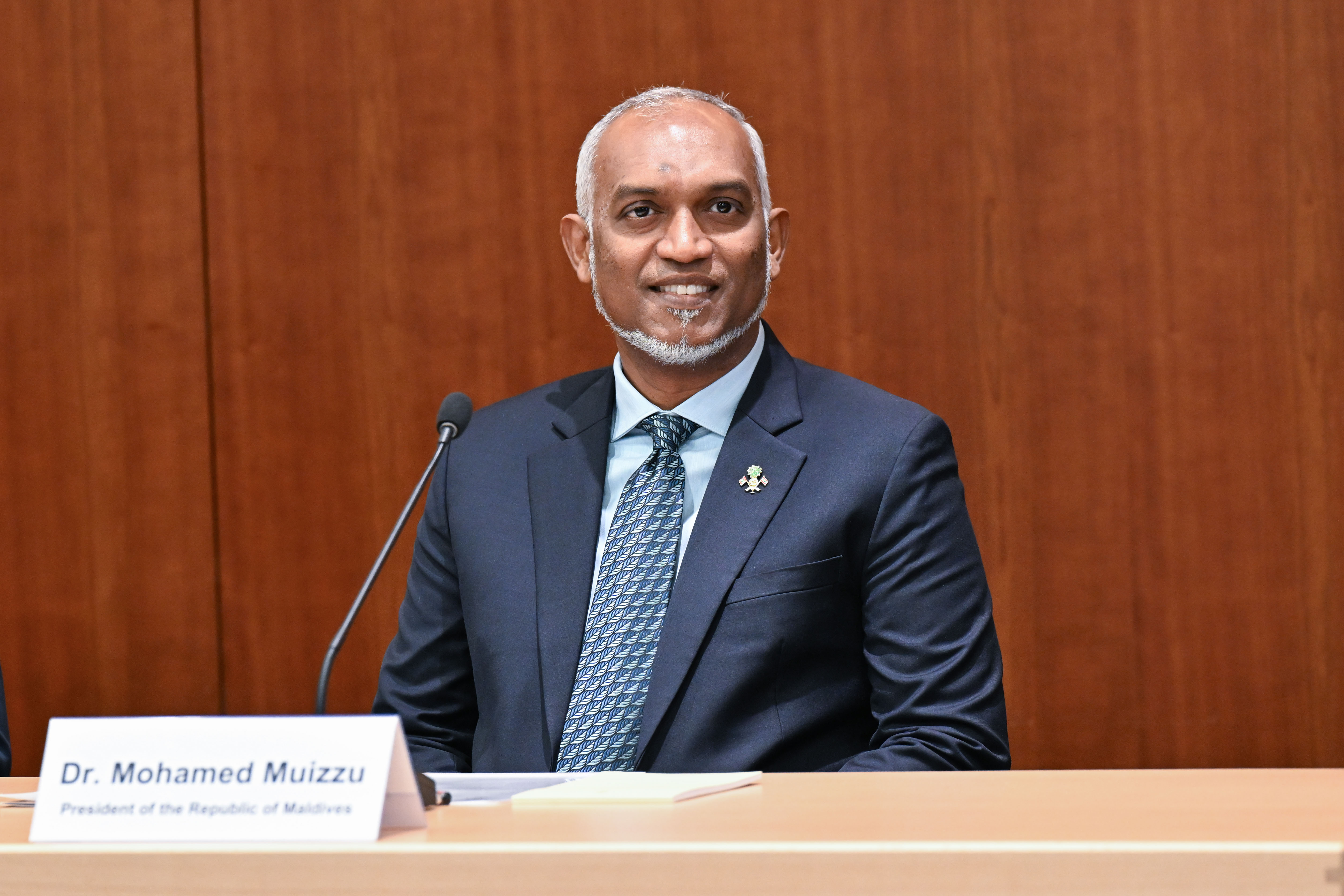
Dr Volker Treier, Head of Foreign Trade and members of the Executive of the German Chamber of Commerce and
Industries,
Excellencies,
Distinguished representatives of the German Chamber of Commerce and Industry,
Members of the Asia-Pacific Committee of German Business,
Esteemed German business leaders,
Ministers,
Our Ambassador to Germany,
Ladies and Gentlemen,
Assalam A’laikum Warah’mathullah and a very good morning.
It is a pleasure to be here in Berlin today and to engage directly with German business leaders whose work shapes industries, systems, and creates long-term value across the world.
Germany is a country the Maldives has long respected, for its economic strength, its engineering capability, its commitment to sustainability, and its culture of building institutions that endure. These are qualities that resonate strongly with the direction we have set for the Maldives.
The global environment we are operating in today is not an easy one by any means. Across economies, we are seeing overlapping pressures; climate risk, economic uncertainty, demographic change, and rapid technological shifts.
Many describe this moment as one of polycrisis, and we are all adapting to this new reality.
For countries like the Maldives, these pressures are not abstract. They are immediate and real. But they also compel us to think differently; to innovate, adapt, and to find solutions that are practical, scalable, and durable.
This is the spirit behind Vision 2040.
Vision 2040 is not a promise of perfection. Rather, it is a commitment to steady, disciplined progress, to strengthen our economy, modernise our institutions, and ensure that growth improves the daily lives of our people while protecting the environment we depend on. Over the past two years, we have focused on turning this vision into reality through decisive action.
We are upgrading critical infrastructure, expanding airport capacity, and advancing sustainable urban development. We are modernising our financial systems, improving access to foreign exchange, and digitalising public services to reduce friction for businesses and citizens alike.
These reforms are already producing results.
Our gross official reserves have reached a historic high of 1.13 billion US dollars, strengthening confidence in the Maldivian economy and improving the circulation of foreign exchange. We have reduced our budget deficit to 5 percent of GDP, and we are maintaining fiscal discipline as a core policy objective going forward.
This renewed confidence is also reflected in investor behaviour, with global technology leaders such as Google choosing the Maldives for strategic, long-term infrastructure investments to strengthen our digital connectivity and resilience.
At the same time, we are investing in people; supporting small and medium-sized enterprises, expanding vocational training, and building the foundations for the creative economy to contribute 15 percent of GDP by 2030, ensuring that growth is not only strong, but inclusive and sustainable.
Ladies and Gentlemen,
Energy transition is another area where necessity has driven innovation. As an island nation, energy security and costs remain critical challenges, highly vulnerable to global crises. By 2028, we aim to meet 33 percent of our national electricity demand through renewable energy, and we are on track to double our installed solar capacity in the near term. Initiatives such as Project Solar City are not only about decarbonisation; they are about resilience, affordability, and replicable solutions for island and coastal economies worldwide.
This is where the Maldives’ experience becomes relevant beyond our borders.
The challenges we face, be it climate exposure, dispersed populations, high logistics costs, are increasingly shared by many across the world. The solutions we develop in response can inform how others navigate similar pressures. In this sense, the Maldives serves as a testing ground for practical and scalable solutions in resilience, energy, infrastructure, and service delivery.
Distinguished Guests,
For German partners, this opens up clear and meaningful areas of collaboration.
Tourism remains a key foundation of our relationship. German investors, tour operators, and financial institutions have contributed significantly to strengthening standards, systems, and long-term confidence in this sector.
In this note, I would like to mention that we have announced next year as Visit Maldives Year in an effort to increase tourist arrivals, expand and diversify our tourism industry, and I would like to invite German tour operators and investors to take part in this endeavour.
The next phase of tourism in the Maldives extends beyond conventional models, as evidenced by Project Ayla, construction phase of which has recently commenced. Development of sustainable townships, with incentives outlined under our Special Economic Zones regime, is an ideal opportunity for investors to explore.
Healthcare is another priority. We are expanding capacity, modernising facilities, and developing specialised services to better serve our population and reduce the need for outbound care. German expertise in medical technology, systems, and training aligns naturally with these objectives.
Banking and financial services are equally important. As our economy grows more complex and digitally integrated, stability, compliance, and innovation in financial services become essential. Here again, German experience offers valuable insight.
Supporting all of this are enabling systems; renewable energy, water and waste management, ports and logistics; areas where precision, long-term planning, and technical excellence make a tangible difference.
To support investment across these sectors, we have strengthened our foreign investments framework, simplified approval processes, and enhanced legal protections. Our objective is straightforward: to provide a transparent, predictable, and rules-based environment that supports long-term partnerships.
Ladies and Gentlemen,
In a world facing shared challenges, no country succeeds in isolation. Progress today depends less on scale and more on collaboration: on partnerships that bring together experience, technology, and shared trust.
The Maldives is not seeking short-term capital or speculative interest. We are looking for partners who are prepared to engage constructively, invest responsibly, and contribute to solutions that last.
Germany’s strengths in engineering, systems design, sustainability, and skills development makes it a natural partner in this journey. We value dialogue, we believe in continuous learning, and we cultivate partnerships that grow stronger over time.
So I invite you to engage openly in today’s discussions, to explore the opportunities presented by our teams, and to consider the Maldives not only as a destination, but as a long-term partner—where solutions developed together can have relevance far beyond our shores.
Thank you.